
Essential 7 Foundation Construction Steps That Prevent Major Failures (A Practical Site Story Every Engineer & Contractor Should Read)
A building may look strong from the outside, but its true strength lies underground — in the foundation.
On many construction sites, failures do not happen because of bad materials, but because the correct Foundation Construction Sequence is ignored.
Let’s understand the right step-by-step foundation construction process through a real site-style story and see why each layer matters.
Avoid Costly Mistakes: Correct Foundation Construction Sequence Explained
Imagine a small residential project.
The owner wants fast progress.
The contractor wants to save cost.
So what happens?
⦁ Excavation is done roughly
⦁ PCC is poured directly on soil
⦁ Cover blocks are adjusted somehow
⦁ Reinforcement touches soil at places
Everything looks fine for now.
But after 3–5 years:
⦁ Cracks appear
⦁ Dampness rises
⦁ Steel starts corroding
⦁ Repair cost becomes higher than savings
This is where correct foundation sequence makes all the difference.
🔁 Correct Step-by-Step Process for Foundation Construction Sequence Work
7 Proven Foundation Construction Steps to Avoid Costly Structural Failures Table of Contents.
-
- Soil Excavation – As Per Structural Drawings
- Additional 6-Inch Excavation – Base Preparation
- White Sand Layer – The Hidden Protector
- Brick Pieces (Where Used) – With a Rule
- PCC / CC – The Backbone Layer
- Cover Blocks (50–75 mm) – Small Item, Big Impact (also on amazon)
- Reinforcement (Rebar) – Final Structural Skeleton
Soil Excavation – As Per Structural Drawings
Foundation work always starts with proper excavation, strictly according to:
⦁ Approved structural drawings
⦁ Footing size
⦁ Depth mentioned by the structural engineer
Random digging or “site judgement” is risky.
Uneven excavation leads to uneven load transfer — the root cause of settlement.
✔️ Correct excavation = correct load path
2️⃣ Additional 6-Inch Excavation – Base Preparation
After reaching the required depth, an extra 6 inches excavation is done.
Why?
⦁ To remove loose soil
⦁ To prepare a uniform and stable base
⦁ To accommodate sand and PCC layers
This step is often skipped, but it plays a critical role in long-term stability.
3️⃣ White Sand Layer – The Hidden Protector
A layer of white sand is spread evenly on the excavated surface.
This layer has three important jobs:
⦁ Breaks capillary action
⦁ Prevents moisture rise
⦁ Acts as a barrier against termites
White sand is preferred because termites cannot easily pass through it.
✔️ No sand = moisture problems in future
4️⃣ Brick Pieces (Where Used) – With a Rule
In some projects, brick ballast or pieces are used.
But there is one strict rule:
Brick pieces must never be in direct contact with soil.
They should always sit above the sand layer, not directly on earth.
Direct soil contact can:
⦁ Trap moisture
⦁ Create weak points
⦁ Reduce foundation life
5️⃣ PCC / CC – The Backbone Layer
PCC (Plain Cement Concrete) is poured next.
This layer:
⦁ Creates a level and strong surface
⦁ Separates structural concrete from soil
⦁ Ensures accurate footing layout and cover
Without PCC:
⦁ Reinforcement position becomes unstable
⦁ Cover thickness becomes irregular
✔️ PCC is not optional — it is mandatory for durability.
6️⃣ Cover Blocks (50–75 mm (Also available on Amazon.) – Small Item, Big Impact
Now comes one of the most misunderstood items on site — cover blocks.
Cover blocks are selected based on:
⦁ Load condition
⦁ Column size
⦁ Type of structure
Generally:
⦁ 50 mm cover block → Residential & light load.
⦁ 75 mm cover block → Heavy load, columns, footings
Their purpose:
⦁ Maintain exact cover
⦁ Keep steel away from moisture
⦁ Ensure long-term corrosion protection
Improvised stones or bricks cannot replace proper cover blocks.
7️⃣ Reinforcement (Rebar) – Final Structural Skeleton
Finally, reinforcement is placed:
⦁ Properly supported on cover blocks
⦁ With correct spacing and anchorage
⦁ L-shaped bars fully embedded in concrete
This ensures:
⦁ Proper load transfer from column to footing
⦁ Strong structural joints
⦁ No direct steel-soil contact
At this stage, the foundation becomes structurally ready.
🧠 Easy-to-Remember Site Memory Lines
👉 Soil → Sand → PCC → Cover Block → Rebar
👉 “First sand, then PCC — only then the foundation becomes strong.”
👉 “Check the load and column size — use 50 to 75 mm cover blocks accordingly.”
These lines are simple, but if followed, they prevent major failures.
🖼️ Visual Understanding of Proper Foundation Sequence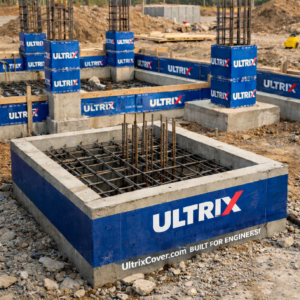
4
Images help engineers, supervisors, and workers understand the correct positioning of layers, especially cover blocks and reinforcement.
The Ultimate Guide to Strong & Safe Foundation Construction
✅ Benefits of Following This Proper Method (In Detail)
1️⃣ Stronger Foundation
⦁ PCC does not touch soil directly
⦁ Sand layer provides a stable base
⦁ Load is distributed uniformly
Result: No differential settlement
2️⃣ Protection Against Moisture
⦁ Sand breaks capillary action
⦁ Moisture does not rise upward
⦁ Concrete and steel remain dry
Result: No dampness issues
3️⃣ Protection from Termites and Insects
⦁ White sand resists termite movement
⦁ Blocks insect paths from below
Result: Long-term protection without chemicals
4️⃣ Prevention of Steel Corrosion
⦁ Proper cover block thickness
⦁ Steel stays away from soil and moisture
Result: Longer steel life, no rust expansion
5️⃣ Proper Load Transfer
⦁ L-bars fully embedded
⦁ Footing, column, and soil work together
Result: Safe and efficient load transfer
6️⃣ Avoidance of Cracks and Future Repairs
⦁ No shortcuts
⦁ Correct layering
⦁ No weak joints
Result: Fewer cracks, lower maintenance cost
Final Thought: Foundation Is Not the Place to Save Money
Many people try to save money below ground because it is “not visible.”
But experienced engineers know:
What you hide underground decides what you see above ground.
Following the correct foundation construction sequence is not extra work —
it is smart construction.
A strong building always starts with a disciplined foundation process
-
UltraTech Cement Construction Guides – Offers practical construction tips like backfilling, curing, etc., from a recognized material manufacturer.