Concrete Slab Casting Process in Construction | Step-by-Step RCC Slab Casting Guide
Introduction
In building construction, RCC slab casting is one of the most important structural activities. A slab forms the floor system of a building and transfers loads to beams and columns, which ultimately transfer the load to the foundation.
If slab casting is not carried out properly, problems such as cracks, leakage, and structural weakness may occur. Therefore, during slab casting it is essential to maintain proper shuttering, reinforcement placement, cover block installation, correct concrete mix, compaction, and curing.
In this article, we will explain the complete slab casting process step by step.
1. Slab Layout and Preparation
Before starting slab casting, the layout must be prepared according to the structural drawing provided by the engineer.
During this stage:
-
Beam and column alignment are checked
-
Slab thickness is verified
-
Reinforcement placement is planned
All measurements should be accurate according to the structural drawing to ensure proper load distribution and structural safety.
2. Shuttering and Centering Work
The first practical step of slab casting is shuttering and centering.
The purpose of shuttering is:
-
To support fresh concrete
-
To give shape to the slab
-
To hold the concrete until it gains strength
Common materials used for shuttering include:
-
Steel plates
-
Wooden planks
-
Aluminum formwork
Centering props are installed underneath the shuttering to support the slab during casting.

3. Application of Shuttering Oil
After installing shuttering, shuttering oil is applied on the surface.
Benefits of shuttering oil:
-
Prevents concrete from sticking to the formwork
-
Makes formwork removal easier
-
Improves the finishing of the concrete surface
This step helps improve overall construction quality.

4. Reinforcement Placement
After shuttering is ready, steel reinforcement bars are installed.
The main components of slab reinforcement include:
-
Main bars
-
Distribution bars
-
Extra bars near beam supports
Steel bars are placed according to the structural design and required spacing.
Typically, reinforcement spacing in slabs ranges between:
100 mm to 200 mm

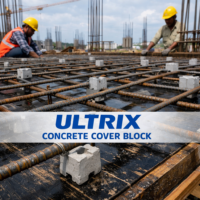
5. Cover Block Placement
Cover blocks are placed beneath the reinforcement bars.
The purpose of cover blocks is:
-
To provide proper concrete cover to reinforcement
-
To protect steel from corrosion
-
To improve structural durability
For slab construction, generally 20 mm cover blocks are used.
Cover blocks keep reinforcement slightly above the shuttering so that concrete fully surrounds the steel bars.
6. Electrical Conduits and Plumbing
Before slab casting, electrical and plumbing components are installed.
These include:
-
Electrical conduits
-
Junction boxes
-
Fan hooks
These components are fixed with the reinforcement so that drilling after slab casting is avoided.
7. Concrete Mix Preparation
Concrete mix is prepared before pouring.
For RCC slabs, commonly used concrete grades are:
-
M20 grade concrete
Concrete mix includes:
-
Cement
-
Sand
-
Aggregate
-
Water
The water/cement = .4 must be properly maintained to achieve the required strength. for example water=.4×50=20L (1 Bag cement weight=50kg)
8. Concrete Pouring (Casting)
Once the concrete mix is ready, it is poured into the slab formwork.
During concrete pouring:
-
Concrete should be spread evenly
-
Cold joints should be avoided
-
Pouring should be continuous
Delays during pouring can reduce slab strength.


9. Concrete Compaction ( Good Quelity Cement)
After pouring concrete, vibrators are used for compaction.
The purpose of compaction is:
-
To remove air voids
-
To prevent honeycombing
-
To increase the density of concrete
Proper compaction significantly improves slab strength and durability.
10. Surface Leveling and Finishing
After compaction, the slab surface is leveled.
Tools used for finishing include:
-
Wooden float
-
Steel trowel
A smooth surface finish makes floor finishing easier later.
11. Initial Setting and Protection
After concrete placement, the slab should not be disturbed for some time.
During this stage the slab should be protected from:
-
Direct sunlight
-
Heavy loads
-
Vibrations
Concrete generally takes about 24 hours for initial setting.
12. Curing Process
Curing is one of the most important steps for developing concrete strength.
The purpose of curing is:
-
To complete cement hydration
-
To prevent cracks
-
To increase concrete strength
Slab curing should be done for at least:
7 to 14 days
Common curing methods include:
-
Water ponding
-
Wet gunny bags
-
Water sprinkling
13. Shuttering Removal
After sufficient strength develops, shuttering can be removed.
Generally, slab shuttering removal time is:
14 to 21 days, depending on span and concrete strength.
Shuttering should be removed carefully to avoid damage to the slab.
14. Quality Checks
After slab casting, proper inspection should be carried out.
Important checks include:
-
Surface cracks
-
Honeycomb areas
-
Surface finish
-
Level differences
If any defects are found, repair work should be done immediately.
Conclusion
Slab casting is a critical structural stage in building construction. Proper shuttering, reinforcement placement, cover block installation, concrete pouring, compaction, and curing are essential for achieving a strong and durable slab.
When slab casting is carried out correctly under proper supervision, the building structure becomes safe, stable, and long-lasting.