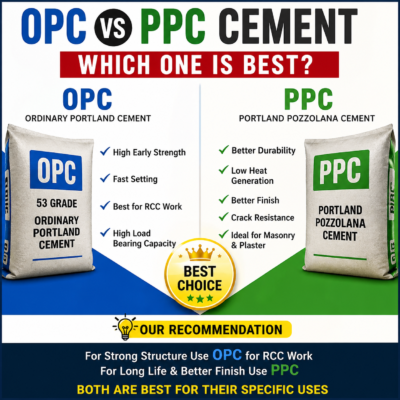
OPC vs PPC Cement: Which Cement is Best for House Construction?
Introduction
Choosing the right cement is one of the most important decisions in construction. The strength, durability, and life of your house depend heavily on the type of cement you use. Among the various types available in the market, the two most commonly used are OPC (Ordinary Portland Cement) and PPC (Portland Pozzolana Cement).
Many people get confused about which cement is better for house construction. In this guide, we will explain everything in simple terms—differences, strength, uses, advantages, and disadvantages—so you can make the right decision.
🏗️ What is OPC Cement?


OPC (Ordinary Portland Cement) is one of the most widely used types of cement in construction. It is manufactured by grinding clinker with gypsum and is known for its high early strength.
🔹 Types of OPC Cement:
- OPC 33 Grade
- OPC 43 Grade
- OPC 53 Grade (highest strength)
🔹 Uses of OPC Cement:
- RCC slab (roof casting)
- Beams and columns
- Foundations
- Roads and heavy-duty construction
💪 Strength:
OPC, especially 53 grade, gains strength very quickly. Within 7 days, it achieves a significant portion of its total strength, making it ideal for structural work.
🧱 What is PPC Cement?


PPC (Portland Pozzolana Cement) is made by blending OPC clinker with pozzolanic materials like fly ash. This makes it more durable and resistant to cracks.
🔹 Uses of PPC Cement:
- Brick masonry
- Plastering work
- General house construction
- Water-related structures (tanks, bathrooms)
💪 Strength:
PPC gains strength slowly compared to OPC but becomes stronger and more durable over time (28–90 days).
⚖️ Difference Between OPC and PPC Cement
| Factor | OPC Cement | PPC Cement |
|---|---|---|
| Early Strength | High | Low |
| Long-Term Strength | Good | Very High |
| Setting Time | Fast | Slow |
| Heat Generation | High | Low |
| Crack Resistance | Low | High |
| Cost | Expensive | Economical |
| Best Use | Structural work | Finishing & masonry |
👍 Advantages of OPC Cement
- High early strength
- Quick setting time
- Ideal for heavy construction
- Faster project completion
- Suitable for RCC structures
👎 Disadvantages of OPC Cement
- Produces more heat during hydration
- Higher chances of cracks
- More expensive
- Less durable in the long run compared to PPC
- Requires proper curing
👍 Advantages of PPC Cement
- Low heat generation
- Better resistance to cracks
- High durability and long life
- Smooth finishing in plastering
- Cost-effective
- Better resistance to water and chemicals
👎 Disadvantages of PPC Cement
- Slow setting time
- Lower early strength
- Delayed removal of shuttering
- Not ideal for urgent construction work
🏠 Which Cement is Best for House Construction?
For building a house, the best approach is to use both OPC and PPC cement strategically:
- Use OPC 53 Grade for:
- Slabs (roof casting)
- Beams and columns
- Foundation work
- Use PPC Cement for:
- Brickwork
- Plastering
- Flooring
- Water-related areas
This combination ensures both strength and long-term durability.
OPC & PPC Cement Available With Us
We supply high-quality OPC and PPC cement suitable for all types of construction work.
✔ What We Offer:
- OPC 43 & 53 Grade Cement
- PPC Cement for masonry & plaster
- Bulk supply available
- Best market rates
- Reliable and fast delivery
👉 Whether you are building a house, doing renovation, or handling a construction project, we can provide the right cement for your needs.
🧠 Expert Tips for Better Results
- Always maintain proper curing (keep surfaces wet for at least 7–14 days)
- Use correct mix ratios (e.g., 1:2:4 for RCC, 1:4 for plastering)
- Avoid using old or expired cement
- Store cement in a dry place
📷 Suggested Image Alt Tags (for SEO)
- OPC cement slab construction
- PPC cement wall plaster finish
- OPC vs PPC cement comparison chart
- best cement for house construction India
📌 Conclusion
Both OPC and PPC cement have their own advantages and ideal applications. OPC is best for structural strength and quick construction, while PPC is better for durability, smooth finishing, and resistance to cracks.
👉 The smart choice is not to pick one over the other, but to use both where they perform best.