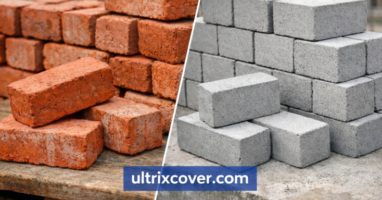
Difference Between Red Brick and Fly Ash Brick (Red Brick vs Fly Ash Brick side by side comparison)
Bricks are among the most essential building materials in the construction industry. Whether constructing a small residential home, a commercial complex, or a multi-story building, the choice of brick directly impacts strength, durability, cost, and long-term performance.
Today, the two most commonly used types are Red Bricks and Fly Ash Bricks. While both serve the same primary purpose—wall construction—their raw materials, manufacturing process, strength, water absorption, finish quality, environmental impact, and overall cost differ significantly.
Understanding the difference between red brick and fly ash brick helps builders, contractors, and homeowners make informed construction decisions.
Red Brick vs Fly Ash Brick: 15 Powerful Differences You Must Know
📑 Table of Contents
-
Introduction
-
What is a Red Brick?
-
What is a Fly Ash Brick?
-
Manufacturing Process Comparison
-
Strength and Durability
-
Water Absorption Capacity
-
Size Accuracy and Finish
-
Mortar and Plaster Consumption
-
Weight Comparison
-
Cost Analysis
-
Environmental Impact
-
Thermal and Sound Insulation
-
Applications in Construction
-
Advantages and Disadvantages
-
Conclusion
1️⃣ Introduction
Traditionally, red clay bricks dominated the construction industry. However, with rapid urbanization and growing environmental concerns, fly ash bricks have emerged as a modern alternative.
The selection between red bricks and fly ash bricks depends on various factors such as:
-
Budget
-
Structural requirements
-
Local availability
-
Environmental regulations
-
Long-term maintenance expectations
Both materials have advantages and limitations, but modern engineering trends increasingly favor fly ash bricks for large-scale and urban construction.
2️⃣ 🔴 What is a Clay Brick?


Red bricks are traditional clay bricks made from natural soil (clay). The clay is molded into rectangular shapes, dried, and then fired in kilns at high temperatures.
Key Characteristics:
-
Reddish color due to iron oxide in clay
-
Slight variation in size and shape
-
Rough surface texture
-
Comparatively heavier
-
Widely used in rural and semi-urban areas
Red bricks have been used for centuries and remain common in small residential and low-rise construction projects.
3️⃣ 🩶 What is a cement Brick?
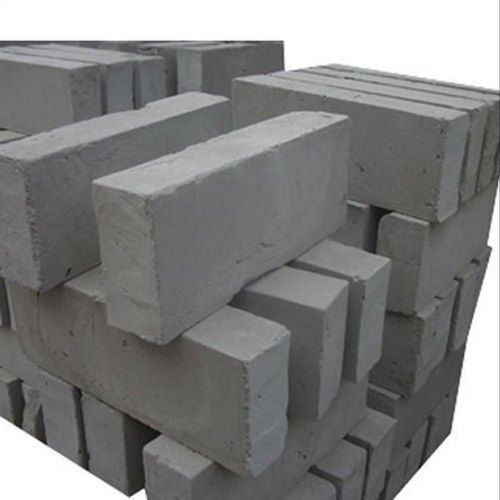
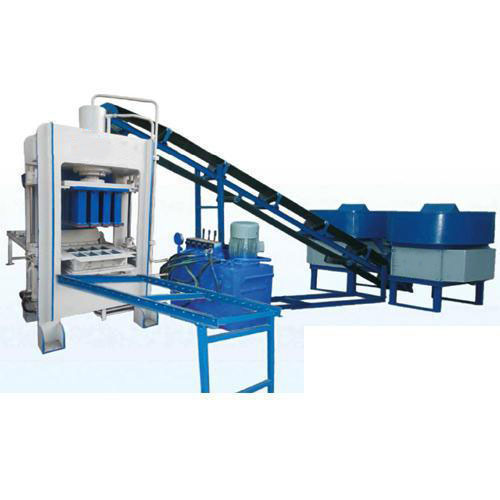

Fly ash bricks are modern construction bricks manufactured using fly ash (a by-product of thermal power plants), cement, sand, and water. These materials are mixed and compressed under high pressure in brick-making machines.
Key Characteristics:
-
Grey or ash color
-
Uniform size and sharp edges
-
Smooth surface finish
-
Lighter weight
-
Machine-manufactured
Fly ash bricks are engineered for better performance, precision, and sustainability.
4️⃣ Manufacturing Process Comparison
| Aspect | Clay Brick | Cement Brick |
|---|---|---|
| Raw Material | Natural Clay | Fly Ash + Cement + Sand |
| Shaping | Manual Molding | Machine Compression |
| Drying | Sun Drying | Controlled Curing |
| Heating | Kiln Firing Required | No Kiln Required |
| Production Speed | Slower | Faster |
Red bricks require kiln firing, which consumes fuel and generates pollution. Fly ash bricks do not require firing, making them more energy-efficient and environmentally friendly.
5️⃣ Strength and Durability
Strength is measured in compressive strength (MPa).
-
Clay Brick: 3.5 – 7.5 MPa
-
Cement Brick: 7.5 – 12 MPa
Fly ash bricks generally offer higher compressive strength, making them more suitable for multi-story buildings and RCC frame structures.
Their uniform manufacturing process reduces cracking and structural irregularities.
6️⃣ Water Absorption Capacity
Water absorption directly affects durability and dampness resistance.
-
Red Brick: 15% – 25%
-
Fly Ash Brick: 10% – 15%
Higher water absorption can lead to dampness and seepage issues. Fly ash bricks perform better in high-moisture or heavy rainfall regions.
7️⃣ Size Accuracy and Finish
Red bricks are manually molded, which may result in slight size variations. This can cause uneven wall alignment.
Fly ash bricks are machine-pressed, ensuring:
-
Consistent dimensions
-
Sharp edges
-
Better alignment
-
Cleaner wall finish
This precision reduces structural defects and improves construction quality.
8️⃣ Mortar and Plaster Consumption
Due to uneven surfaces and size variations, red bricks require:
-
More mortar for alignment
-
Thicker plaster to achieve smooth finishing
Fly ash bricks require:
-
Less mortar
-
Thinner plaster
This significantly reduces cement and sand consumption, lowering overall construction cost.
9️⃣ Weight Comparison
Red bricks are heavier compared to fly ash bricks.
Lighter bricks reduce:
-
Dead load on the structure
-
Stress on beams and columns
-
Foundation cost (in certain projects)
This makes fly ash bricks ideal for high-rise construction.
🔟 Cost Analysis
Initially, red bricks may appear cheaper in some regions. However, overall construction cost includes:
-
Mortar consumption
-
Plaster thickness
-
Labor cost
-
Structural load considerations
-
Long-term maintenance
Fly ash bricks may cost slightly more per unit but reduce overall material usage and maintenance cost, making them more economical in the long run.
1️⃣1️⃣ Environmental Impact
🔴 Red Brick:
-
Requires large-scale clay excavation
-
Destroys fertile soil
-
Produces pollution during kiln firing
🩶 Fly Ash Brick:
-
Uses industrial waste
-
Reduces landfill waste
-
No kiln emissions
-
More eco-friendly
From a sustainability perspective, Cement bricks are a superior choice.
1️⃣2️⃣ Thermal and Sound Insulation
Clay bricks provide decent thermal insulation due to their density.
Cement bricks also offer strong thermal performance and often better heat resistance due to controlled composition.
In sound insulation, both perform similarly. However, wall thickness plays a greater role than brick type in soundproofing.
1️⃣3️⃣ Applications in Construction
Red Bricks Used In:
-
Rural housing
-
Low-rise residential buildings
-
Traditional construction projects
Fly Ash Bricks Preferred For:
-
Urban housing
-
Commercial complexes
-
Government projects
-
Multi-story RCC buildings
-
Green building projects
Modern developers increasingly prefer Cement bricks due to their structural efficiency and eco-compliance.
1️⃣4️⃣ Advantages and Disadvantages
🔴 Red Brick
Advantages:
-
Traditional and widely available
-
Easy local production
-
Familiar to most masons
Disadvantages:
-
Higher water absorption
-
Uneven dimensions
-
Environmental damage
-
Higher plaster consumption
🩶 Fly Ash Brick
Advantages:
-
Higher compressive strength
-
Uniform size and finish
-
Lower water absorption
-
Reduced mortar and plaster usage
-
Environmentally friendly
Disadvantages:
-
Quality depends on manufacturer
-
Limited availability in remote areas
-
Requires proper curing
1️⃣5️⃣ Conclusion
Both bricks have their place in construction. Clay bricks remain suitable for traditional, small-scale, and low-rise construction, especially where local availability and lower upfront cost are important factors.
However, Cement bricks offer clear technical and environmental advantages. They provide higher strength, lower water absorption, better dimensional accuracy, reduced plaster consumption, and a more sustainable manufacturing process.
In today’s construction industry—where durability, cost-efficiency, and sustainability are major priorities—fly ash bricks are increasingly becoming the preferred choice for urban and multi-story construction projects.
Ultimately, the correct selection should be based on project requirements, structural design, environmental conditions, and budget considerations.